“Now let us make a covenant before our God to send away all these women and their children, in accordance with the counsel of my lord and of those who fear the commands of our God. Let it be done according to the Law.” – Ezra 10:3
Should repentance remove responsibility?[1]
My daughter loves Barbies. She plays with them just about every single day. Because of this, in our living room, we’ve got a large plastic bin for Barbie and Barbie accessories. It’s filled with lots and lots of little plastic dolls, shoes, outfits, miniature cutlery, and other sorts of things like that.
We do have one rule that we ask her to follow: she isn’t supposed to dump this bin completely out onto the floor. If she does, it is on her to pick it all back up.
This is also a rule my daughter tends to forget.
Most evenings in our house follow a similar pattern. An hour or so before bedtime, my daughter will take out her Barbies. She will inevitably dump the bin out into the living room floor. About 5 minutes before bed, we will then ask her to put her Barbies back in the bin. It is then that we remind her of our rule. Like clockwork, we are met with the phrase: “Sorry! I forgot!” In this case, repentance doesn’t remove responsibility. My wife and I will help clean up, but the Barbies need to go back in the bin.
Similarly, when I was in college, I worked as a teacher’s assistant. This meant that I taught a few lower-level classes now and then, but I mostly graded homework and student papers. And there were a few unfortunate occasions in which I caught people plagiarizing. I’d get two papers submitted that were almost identical. Or sometimes, a student would buy a pre-written essay online and submit it as their own. When this happened, it was my job to confront the negligent students and fail them from the class. It was harsh, but necessary to maintain academic integrity.
Every student, both during freshman orientation and within each class’s syllabus, was told about the school’s plagiarism policy. When I had to confront the offending students about their copying, many would act like they did not know about the rule. They’d profusely apologize and ask if there was anything they could do that might grant them grace, and depending on the professor, they’d sometimes receive it! But mostly, and even though they rightly repented of their wrongdoing, they still had to face the consequences of their actions.
Here is even another related story. However, one takes a bit longer to set up.
Ezra Shirks Responsibility
Even though the book of Ezra is named after the character “Ezra,” God’s priest doesn’t show up this book until the story is almost over.[2]
Let me summarize what happens before he arrives.
God’s people had failed to do what God wanted them to do over and over. They had turned away from Him and toward sin. Because of this, God sent His people into exile. Babylonian armies came and invaded the nation of Judah and burned down the capital city Jerusalem. They ripped apart the Temple and stole all of the gold and precious jewels stored inside. They then took many of the healthy young people, community leaders, and teachers and forcibly scattered them so that they wouldn’t have a way to communicate with one another.
But this wasn’t the end for God’s people. Even though Israel had sinned against God, God still loved them. Even though they failed Him, God still wanted to use them for His purposes.
Towards that end, after a period of about 50 years, the LORD empowered the nation of Persia and enabled them to overtake Babylon (1:1). And Persian leaders were a lot kinder to God’s people than Babylonian leaders. They allowed the scattered remnant of Israel to return to their land and rebuild the Temple (1:2-4). Persia even returned a portion of the stolen gold and treasures that were plundered by Babylon (1:9). The once-exiled people of God are overjoyed and they immediately begin rebuilding. They even resume some of the feasts and festivals they had been unable, or unwilling, to celebrate during their time of exile. But their joy was complicated by disappointment when the older generation saw that the new Temple’s foundation was much smaller than Solomon’s Temple (3:12–13).
Then, some “enemies” of God’s people show up and ask the remnant Israelites if they can assist them in their building efforts (4:1). The identity of these enemies is a bit mysterious. Some scholars believe that they actually were Israelites (literally – people from the Northern Kingdom) who were not sent away by Assyria but remained in the land. Whoever they were, though, their help is immediately rejected. But the enemies don’t leave quietly. They write to the Persian kings with the hope of changing Persia’s mind. If they couldn’t help out, they wanted the building projects to stop completely (4:6-24). And they’re successful. The people of God pause the reconstruction of Jerusalem and the Temple for several years. But the prophet Haggai shows up to encourage God’s people (5:1), and the remnant eventually complete the construction of the Temple. They are even able to celebrate the festival of Passover within it’s walls (6:19-22).
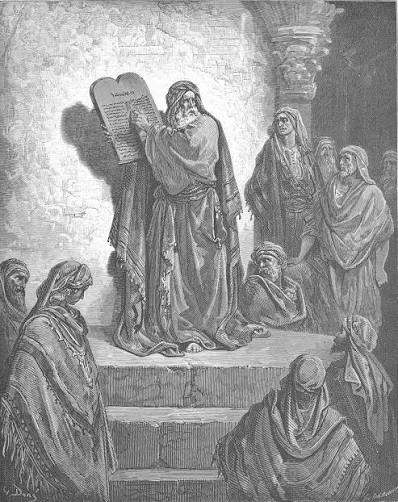
It’s after all of this that Ezra shows up.
He had been in Babylon working as a scholar studying Old Testament law. But Persia, under king Artaxerxes, commissioned him and several others to return to Jerusalem with the rest of the stolen Temple artifacts (5:10, 18-20).
Once Ezra arrives, he is almost immediately confronted by a group of Israelite leaders who confess to him that “The people of Israel, including the priests and the Levites, have not kept themselves separate from the neighboring peoples with their detestable practices, like those of the Canaanites, Hittites, Perizzites, Jebusites, Ammonites, Moabites, Egyptians and Amorites. They have taken some of their daughters as wives for themselves and their sons, and have mingled the holy race with the peoples around them. And the leaders and officials have led the way in this unfaithfulness” (9:1-2). This troubles Ezra greatly, as it was one of the same sins that God’s people committed which led them to their exile! He “[tears his] tunic and cloak, pull[s] hair from [his] head and beard and [sits] down appalled” (9:3).
He then gets to work on a potential solution.
Ezra prays to the LORD and confesses the nation’s continued sin. A large crowd of Israelites then join Ezra in his act of repentance. Men, women, children all pray to the LORD for forgiveness and weep bitterly at their mistake (10:1). That is to say, the nation shows genuine contrition for their breaking of Torah. So far so good!
But here’s where it takes a bit of a turn.
Ezra asks that those among the remnant who have foreign wives and children should separate themselves from their families. That is, they should cast them out of the city. A small number of people disagree with Ezra’s ruling (10:15), but almost everyone else believes it to be an excellent idea. So, over the course of the next few months, the remnant of Israel effectively kicks several hundred women and children to the curb. In a patrilineal society, where women and children depended heavily on their husbands and fathers for security and provision, this surely would have been devastating. It would have been like sending them to their deaths.
Harsh, right? I think so.
Ezra, Interpreted
Now, it should be mentioned that this story is often interpreted positively.
That is to say, Ezra and the remnant Israelites are often applauded for taking such drastic action. This is because many people see this as another instance of one of those one-time directives that God sometimes gives in order to convince His people that He is serious about something.
For example, think about when Korah and his sons challenge Moses and Aaron for the priesthood in the book of Numbers. God responds to their rebellion by doing this: “the earth opened its mouth and swallowed them and their households, and all those associated with Korah, together with their possessions” (Numbers 16:32). The Lord was serious about the way He had set up his priesthood. He wanted to be sure that Israel took it seriously. Similarly, God commanded Joshua to put Achan to death after Achan stole treasure from Jericho. There’s even the story about Ananias and Saphira lying to the Holy Spirit in Acts 5. God was serious about the establishment of His church and did not want hypocrisy and dishonesty to taint the budding community.
What’s different with all of these stories and Ezra, however, is that God was directly involved with all of that action. In Ezra, He wasn’t. Sure, Ezra and the Israelite priests repented of their sin and prayed. But we are never told that God and Ezra had direct correspondence[3] like we are with Moses, Joshua, Peter, and so on.
Others have made the case that Ezra and the Israelites acted out of necessity. If the community wanted to remain obedient to Torah, they had to take this drastic measure in order to purge that which was keeping them from total faithfulness.
It is absolutely true that Torah did forbid the Israelites from marrying foreigners. In Deuteronomy 7:3-4, right before God’s people entered into the Promised Land, the Lord commanded them to “not intermarry with [the people in the land]. Do not give your daughters to their sons or take their daughters for your sons, for they will turn your children away from following me to serve other gods, and the Lord’s anger will burn against you and will quickly destroy you.”
God’s desire was that His nation Israel, through the following of God’s law, would become distinct among the nations. Through their social practices, ethics, and boundary laws, God’s people were meant to give their neighbors a clear picture of what God’s grace and love look like. If the people of Israel, especially at such a critical point in the formation of their nation, were to immediately intermarry with surrounding nations, that distinct witness would quickly become muddied.
But we should not forget that these commands about foreigners aren’t the only ones found in Torah. For example, consider:
- Exodus 23:9 – “Do not oppress a foreigner; you yourselves know how it feels to be foreigners, because you were foreigners in Egypt.”
- Leviticus 19:33-34 – “When a foreigner resides among you in your land, do not mistreat them.The foreigner residing among you must be treated as your native-born. Love them as yourself, for you were foreigners in Egypt. I am the Lord your God.”
- Deuteronomy 14:28-29 – “At the end of every three years, bring all the tithes of that year’s produce and store it in your towns, so that the Levites (who have no allotment or inheritance of their own) and the foreigners, the fatherless and the widows who live in your towns may come and eat and be satisfied, and so that the Lord your God may bless you in all the work of your hands.”
None of the above passages have anything to do with marriage or divorce. However, they do portray an important ethic. Israel was meant to be kind!
I’m not so sure that any kindness was on display in Ezra 10.
Furthermore, there are several Old Testament passages that do have something to do with marrying foreigners that need to be brought up. The patriarch Joseph married an Egyptian woman named Asenath. Their two sons, Manasseh and Ephraim, became the heads of two of the tribes of Israel. Consider that Zipporah, Moses’ wife, was a Midianite. Think about how Caleb, the spy who helped scout out the Promised Land in the book of Joshua, was a Kenizzite by birth (Joshua 14:6). Don’t forget that the Canaanite Rahab, the woman who helped the Israelites conquer Jericho, is mentioned in the genealogy of Jesus (Matthew 1:5). There’s also the entire narrative of Ruth that’s extremely relevant, too.
What does all of this mean? When Torah prohibits Israelites from marrying foreign wives, the marriage itself wasn’t necessarily the problem. The act was prohibited in order to prevent idolatry. However, the sin of idolatry is never mentioned in the book of Ezra except in hindsight. That was the sin that had sent them into exile. But, and again, this sin is never once mentioned in connection with those among the remnant married to foreign wives.
Was Ezra’s decree a case of overcorrection? Possibly. Was his decree an example of not accepting the responsibility for something after repenting from something? Absolutely. Was Ezra’s insistence on mass divorce wrong? One of his contemporaries seemed to think so. Malachi, a prophet to the remnant of Israel had this to say about the situation: “The man who hates and divorces his wife,” says the Lord, the God of Israel, “does violence to the one he should protect,” says the Lord Almighty” (Malachi 2:16).
Why it Matters
I think that there are two important lessons that we should take away from all of this:
1. Prescriptive vs Descriptive Reading
There are parts of our Bible that are prescriptive. Many passages in scripture give us direct commands. They tell us what to do, or how we should live. Yet, other parts of the Bible are merely descriptive. That is to say, much of Scripture consists of history or poetry written to preserve a record of events in the lives of God’s people. Biblical authors had agendas, of course. They didn’t record what they did without reason. But their reason wasn’t always to give direct step-by-step instructions on how God’s people should act.
David’s killing of Goliath isn’t meant to be understood as directive to go out and kill extra tall people. Gideon’s fleece prayer isn’t an invitation for us to pray in the same way ourselves. And Ezra’s enactment of mass divorce isn’t a green-light for us either.
We can find a very dark history behind a number of scripture passages that have been read prescriptively when they should have been read descriptively, Ezra 10 being one of them. This chapter has historically been used to uphold anti-miscegenation laws and “social equality;” in other words, it was weaponized to justify the belief that people with different skin color should not marry. It’s also used by some today to argue for cruel immigration policy and even violence.[4]
Do not read Ezra 10 like this! This is not what the biblical author is attempting to convey.
3. Repentance Doesn’t Remove Responsibility
When my daughter dumps all of the Barbies out of her toy bin, she’s required to pick them all back up. Even if she apologizes for doing so, she’s still on the hook to clean up.
Some within the remnant of those who returned from exile had married women from foreign nations. This was something that was outside the bounds of what God wanted for them, mostly because He did not want them to adopt the idolatry of the surrounding nations. Israel apologized. They showed contrition. Ezra, on their behalf, prayed to the Lord and asked for forgiveness. But by sending away all of these women and children, I believe that the remnant did not take total responsibility for their action. They should have continued to care for them. They should have allowed them to remain within the walls of the rebuilt Jerusalem. If the concern was that these women might turn their husbands away from God, why not teach them about Israel’s faith and give them the opportunity to embrace it rather than simply excluding them?
A part of genuine repentance is accepting the consequences for our wrongdoings. In fact, taking responsibility for the harm we’ve caused can be one of the clearest ways we show those we’ve hurt that we’re serious about changing our ways.
[1] I am writing this blog primarily for myself. The best way that I process information is by writing it out. The church in which I serve has been going through the book of Ezra in its youth program, and I am gearing up to teach on Ezra 9-10. It’s a troubling passage, at least to me! So here’s me wrestling with the text. Maybe you’ll find it helpful, too.
[2] Actually, it’s a bit more complicated than that. Ezra-Nehemiah were originally one book. And this singular book revolves around three characters: Zerubbabel, Ezra, and Nehemiah. Ezra 1-6 is Zerubbabel’s story, Ezra 7-10 is Ezra’s story, and Nehemiah 1-13 is Nehemiah’s story. And just like I’ll point out in this blog, each one of these three stories ends rather disappointingly. All three of these men had hopeful starts, but all three of them fumble their endings.
[3] Or, we’re never told that God directly acted in some way. In the case of Acts, Peter isn’t shown to be talking directly with the Holy Spirit but it’s the Spirit that kills Ananias and Saphira. Peter doesn’t act on his own volition. This is also the case with Paul and the Corinthian community. Paul mentions to those in Corinth that some of them have been getting sick and dying because of their poor table practices when partaking in the Lord’s Supper. God was teaching the early church that hospitality was vital for their witness within the world. But the deaths in Corinth weren’t Paul’s idea. God acted on his own.
[4] Hernández-Marcial, Lydia. (2025). Threatened identity: Ezra, Nehemiah, and Christian nationalism in the United States. Review & Expositor. 121. 213-220.

