“This, then, is how you should pray: “’Our Father in heaven, hallowed be your name…” -Matthew 6:9
What follows is an edited manuscript of a sermon that I delivered on November, 23 2025. My church has been going through the Heidelberg Catechism this calendar year, and we’ve now made it to the questions that have to do with the Lord’s Prayer. And as the Lord’s Prayer is located within Jesus’ Sermon on the Mount, this post could also serve as a continuation of the blog series I started this past summer.
That’s right. I’m double dipping.
Hallowed Be Your Name
Every couple of months, my smart phone forces through a software update.
And each time this happens, I am faced with a terms and conditions document which I am supposed to read through and then check the box that says I agree with its wording before it updates. I need to confess something. I always check the box that states that I’ve read and agree to the content. I never actually read what it says.
And my guess is that I’m probably not alone in doing that, right? We are all faced with language, or documents, or assumedly familiar stuff that we skim through because we already figure we know what it says or means. Terms and conditions. Employee handbooks. Rental car or hotel agreements. Cookies consent banners or privacy policies on websites. Warning labels. Instruction manuals for new appliances or furniture. School syllabi. Promotional emails.
I mean, some of us might read some of this stuff.
Yet by and large, we sort of have a preconceived idea of their content before we ever lay our eyes on them. We generally know what they are going to say. This enables us to feel comfortable with our skimming.
But, you know, this sort of thing can happen with certain parts of scripture, too. There might be portions of the Bible that have become so familiar to us that they’ve now lost their original meaning in our minds. They take on a sort of amorphous quality. And when we come across them in our devotions, we might either feel tempted to skim, or even skip them, because we just assume that we know all that it’s trying to communicate.
The Lord’s Prayer, at least to me, is one of those types of passages.
I memorized it as a kid. And I almost exclusively recite or read it as a whole unit. But I rarely pause to think about what the individual lines within the prayer actually mean. More pointedly, what am I, or what are we truly saying when we pray “may your name be hallowed?”
The Structure of Matthew 6:9-10
We, with help from the Lord’s Day 47 in the Heidelberg Catechism, are going to explore what is commonly called the “first petition” within the Lord’s Prayer.
And specifically, I think that there are two things we should understand about this petition that then might enable us, in good conscience, to check that metaphorical box prompting us to state if we have actually read and agree with its content.
Before we get to those two things, however, I’d like us to go back and re-read Matthew 6:9 and its immediate context.
Last week, we walked through the first line of the Lord’s prayer: “Our Father in heaven.” That line, in the sequence of things, serves as the address. It tells us who we are praying to. We are praying to our Father, the Creator God who is located within the heavenly realm.
Seven petitions follow this address.
The first three that we just read all revolve around large-scale promises that God has already made. The final four that we didn’t read are a bit more personal and have to do with issues that we might face in our daily lives like forgiveness and temptation and tangible needs. But, again, the first three petitions are all directed toward the Father and act as invocations. They all ask that God actually do what He has claimed that He is going to do. And they all, sort of, are saying the same thing, just from slightly different angles.
In fact, if you like structure and organization, if you are a type-A person like me, you might like this.
The first three petitions in the Lord’s Prayer form a poetic chiasm. The lines mirror themselves.
The “Our Father” address serves as its title. “Who dwells in the heavens” mirrors the line “on earth as it is in heaven.” “May your name be hallowed” mirrors “your will be done.” And the line “your kingdom come” serves as the pin in the center of the poem that gives meaning to the entire structure.
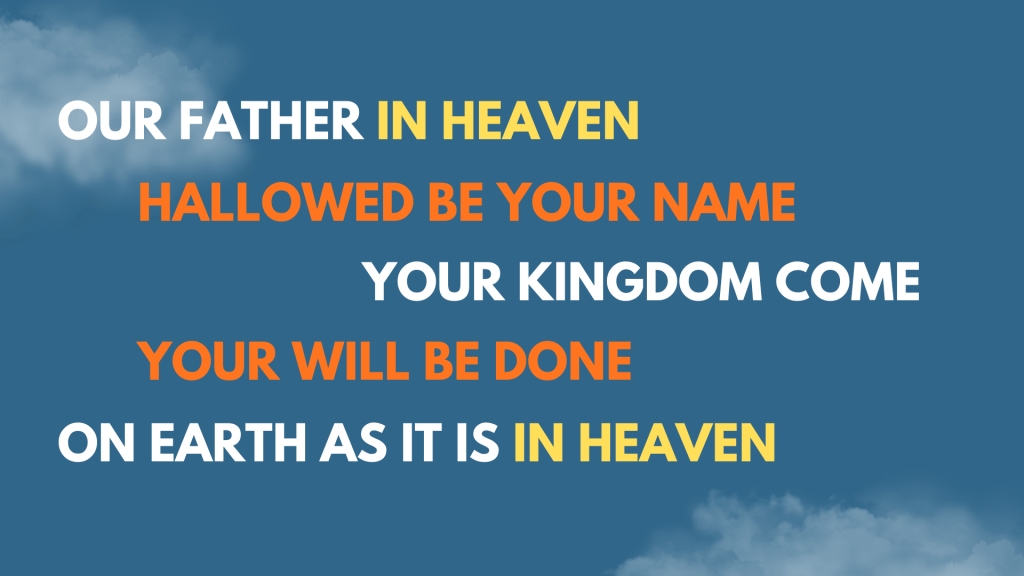
However, our focus today is not on all three of the petitions but only the first one as is described in the Lord’s Day 47. Yet, considering that structure, you might be asking yourself: what does God’s name have to do with God’s kingdom? What does holiness have to do with God’s will? Why is all of that poetically connected?
And what specifically does it mean when we pray this first petition today?
Well, consider this:
1. When we pray “hallowed be your name,” we connect ourselves to the ongoing story of scripture.
From the very beginning of the Bible, we see that God is a holy creator, set apart over his creation. We also see that God created humanity as his delegates on earth.
Even though God is other, He did not want to be absent from creation, but hoped to use us humans as his representatives with whom he’d have a special relationship. God is good. God cares for all things. And we were to make him known by our goodness and our care for all things as a reflection of His.
However, of course, we messed this up.
Sin entered into God’s good world. And after it did, humanity repeatedly chose to represent sinfulness and violence instead of God’s goodness.
But God did not want to abandon his creation. Out of love, and in order to be a blessing to all peoples of the earth, God chose for himself a particular people group with whom he tasked to carry his name: Israel.
Israel was then given the law. And within this law, God’s set-apart people were instructed on how to represent God’s name amidst the nations of the earth who were all now worshipping false gods and idols. As Exodus 19:6 states, the Lord was making for himself a kingdom of priests and a holy nation who were to constantly choose God over all else so that they might lead the nations around them to do the same. And as Exodus 20:7, or the third commandment states, “You shall not make wrongful use of the name of the Lord your God.” That is to say, as God’s representatives, they were not to associate God’s name with anything that God did not already place his name upon.
But, of course, they failed in this, too.
In the period of the Judges, Israel’s leadership constantly failed to represent God’s name. They lead Israel away from the law and toward idolatry. Eventually, God’s people even chose to reject God as king over their nation and instead wanted a human ruler like the nations around them. God conceded, but warned them that it would not go well. Their kings would want to make their own name’s great and would abandon God. And when they did, the nation would face consequences.
This is exactly what happened. And the nation did face consequences. Israel split in half and the northern tribes were carried off into exile under the Assyrians. And a century later, the southern tribes were ripped from their land by the Babylonians.
Yet, even in exile, and even though God’s people failed over and over to represent God’s good name, the Lord did not abandon his plan.
Check out what Ezekiel 36 has to say about all of this:
“I scattered them among the nations, and they were dispersed through the countries; in accordance with their conduct and their deeds I judged them. But when they came to the nations, wherever they came, they profaned my holy name, in that it was said of them, ‘These are the people of the Lord, and yet they had to go out of his land.’ But I had concern for my holy name, which the house of Israel had profaned among the nations to which they came.
Therefore say to the house of Israel, Thus says the Lord God: It is not for your sake, O house of Israel, that I am about to act, but for the sake of my holy name, which you have profaned among the nations to which you came. I will sanctify my great name, which has been profaned among the nations, and which you have profaned among them; and the nations shall know that I am the Lord, says the Lord God, when through you I display my holiness before their eyes. I will take you from the nations, and gather you from all the countries, and bring you into your own land. I will sprinkle clean water upon you, and you shall be clean from all your uncleannesses, and from all your idols I will cleanse you. A new heart I will give you, and a new spirit I will put within you; and I will remove from your body the heart of stone and give you a heart of flesh. I will put my spirit within you, and make you follow my statutes and be careful to observe my ordinances. Then you shall live in the land that I gave to your ancestors; and you shall be my people, and I will be your God.” – Ezekiel 36:19-28
What does this mean?
Even though Israel repeatedly failed to make God’s name known among the nations, and were sent into exile because of it, God himself would soon act to bring his people back into the land that they were once promised. And this return to exile would not be on account of any good action that Israel had taken to deserve a return. But because of God’s concern for his own name, He was going to bring a remnant back home so that the nations of the earth would be reminded of God’s holy might.
But more than even this, God was going to give his people a renewed heart and spirit.
The inclination of every human heart is towards evil. We, even on our best attempts to do good, choose sin. But God has promised to heal this problem within us. We cannot do it on our own, so God has promised to step in and fix this issue himself.
When we pray “hallowed be your name,” we are praying for that.
We are praying that God would make good on the entire promise that He gave to his people Israel way back when as is recorded in Ezekiel 36. Because the Lord did lead a remnant of Israel out from under Persian rule, and he did re-establish his people in Jerusalem under Nehemiah. But God did not completely heal their hearts or spirits on their return from exile.
And in Jesus, we too have been grafted into the people of God and have been promised renewed hearts and spirits as well, ones that will always choose goodness and love over sin. But we won’t experience such a thing entirely until Jesus’ kingdom comes in its fullness.
When we pray the Lord’s Prayer, we pray that God would act soon to bring all of this about. It is a request that God hallow his own name, so that all would truly know of his might, his love, his goodness, and his grace.
So, when we pray this first petition, we connect ourselves to the ongoing story of scripture.
But secondly, in this prayer, we are asking God to help us become good representatives of his name while we wait for the culmination of that story, his kingdom come.
In other words:
2. When we pray “hallowed be your name,” we ask that we might know God rightly so that we can properly represent His holy name.
Matthew 6:9, or at least the part we’ve been focusing on, is grammatically passive. That is to say, when we pray this, we are asking God to perform the action.
But there’s a bit of a paradox here, right? Because the way that God’s name is understood to be holy is when God’s people properly represent it.
God is already holy, and He has already promised that he will one day clearly make his holiness known to all the earth. But while we wait for the culmination of that promise, this petition asks God to grant us a deeper admiration of his holiness which should then inspire us to make God’s name known.
I think that the Heidelberg does a good job of explaining this.
Here’s what Lord’s Day 47 has to say about Matthew 6:9 –
“Q 122 – What is the first petition?
A. ‘Hallowed be your name.’ That is: Grant us first of all that we may rightly know you, and sanctify, glorify, and praise you in all your works – in which shine forth your almighty power, wisdom, goodness, righteousness, mercy, and truth. Grant us also that we may so direct our whole life – our thoughts, words, and actions – that your name is not blasphemed because of us but always honored and praised.”
Have you ever eaten somewhere, or paid for a service from someplace, and one of the company’s employees ended up turning you off from that company altogether?
About ten years ago, Tori and I had just moved to Grand Rapids and we were in need of a second vehicle.
There is a car dealership over there that owns what seems like all of the car lots on one of the main stretches of road. They actually have lots in more than just Grand Rapids, too. They are sort of the car lot McDonalds in West Michigan. And we had found a car we wanted to test drive at one of their locations and had met with one of their dealers so that they could copy our driver’s licenses.
But, somehow, in the process of taking my card back to the copy machine, the dealer misplaced my driver’s license. And instead of owning up to it, they doubled down on denying that I had ever given it to them. They then attempted to use my missing card as a sales leverage. They’d pay for a replacement from the Secretary of State if I could assure them that I’d buy one of their cars.
I should say that I’m positive that there are great people working for this company. And I’m sure that the company itself probably has rules against these types of dishonest sales tactics. Maybe this dealer was just having a bad day.
But this experience really soured this car lot’s reputation for Tori and I. We have not been to one of their car lots since.
God desires us to know him rightly so that we might represent him well.
This is because when God’s people misrepresent God, we run risk of souring His reputation by declaring to the world a false image of God. God is holy. God is good. God is righteous. God is merciful. God is loving. God is just. So, when God’s people act contrary to these characteristics, especially when we are claiming to be working for or serving God in that moment, we commit the act of blasphemy.
Taking God’s name in vain by using “Jesus” a swear word is blasphemous, but we are tricking ourselves if we think that that is the only way that we might use the Lord’s name lightly.
I am sure we’d all agree that something like the German soldiers who wore the label Gott mit Uns, “God with Us,” on their helmets during WWII were committing a terribly blasphemous action. Our God does not condone the horror and evil of Nazism. But if we were to turn on our TVs or phones even today, we might find politicians from all sides of the political spectrum using God’s name in prayer or in their speeches as a way to rally us to their personal partisan causes. We might even find pastors or other religious leaders, who, speaking from a place of authority, attach God’s name to their own bigotry or cruelty or injustice or greed.
In John 13:35, Jesus said that all of his followers should be known by their love for others. When we claim to follow Jesus but are instead known by our bullying, mockery, or our contempt for others, we are souring God’s name.
Let me revisit that question about eating somewhere, or paying for a service from some place, but from the other side this time.
Do you know that the lunch period right after churches get out on Sundays are often considered the worst times to work for people in the food industry? That’s because, by and large, Christians have a reputation of being both smug and a bit stingy. And whether or not we agree with this assessment doesn’t take away from the many, many stories that have been shared about Christians behaving rather rude to service workers and then following that up with a poor tip. Or no tip, but instead a Bible tract or something.
But our God is not a smug God. And He’s generous! He gives lavishly even when we as the recipients of his gifts do not deserve them in the slightest.
As believers, we need to remember who we are representing.
Our God is holy. And through his holy actions, we see that he is loving, just, gracious, and merciful. We would do well to meditate on these things before we act, and especially when we are claiming to be working for or serving God in that moment.
But, as believers, we also need to remember that we won’t be perfect at this either.
The story of scripture is one of failure and rescue. Adam and Eve failed as God’s delegates. Israel was sent to exile multiple times because they discredited God’s holy name. And just like them, we too have been caught up within a system of sinfulness.
Thank goodness that Jesus has made a way for us to choose God.
And thank goodness that Jesus has promised us renewed hearts and spirits at the culmination of his kingdom, hearts and spirits that will always choose to properly represent God’s good name.
“Hallowed Be Your Name” in our Daily Prayers
Before we wrap things up, I’d like to briefly offer up one practical way we might think to apply this petition within the Lord’s Prayer during our time of daily prayer.
The Heidelberg Day 47 explains that the Lord’s holiness is made evident by God’s almighty power, wisdom, goodness, righteousness, mercy, and truth. And further, when we pray “may God’s name be hallowed,” we are asking God to remind us of his holiness so that we might become little reflections of it. But what do those adjectives actually mean?
We might not give much thought to a terms and conditions document, or something of a similar nature, because we often assume that we know all they have to convey. But if we have been called to represent God well, it would do us well to slow down and prayerfully meditate on what makes God unique.
Towards that end, we could spend our devotional time in Jonah 3-4, reading specifically to learn what it might mean that God is merciful. And while we do so, we could pray and ask God to reveal to us his mercy within this story and within our own lives. We could spend our devotional time in Exodus 16-17, reading specifically to learn what it means that God is faithful. And while we read that, we can ask the Spirit to illuminate that text for us and then, in turn, praise God in prayer for the ways that he has been faithful to us in our personal lives. We could even spend time in the book of Ruth with the specific goal of understanding God’s goodness. We could follow that up by praising God in prayer for His goodness.
Supplementally, I’ve found that A.W. Tozer’s book “The Knowledge of the Holy”1 does a great job at walking us through God’s attributes, chapter by chapter, in small digestible bits. Or, for someone a bit closer to our denominational tradition, R.C. Sproul has a book titled “The Holiness of God”2 that does similar.
But, again, prayerfully meditating on the attributes of God, or that which reveals God’s holiness, is a very worthwhile thing to do.
It can help us understanding what we mean when we pray the first petition of the Lord’s prayer.
Or like the Heidelberg puts it, it might help orient our thoughts, words, and our actions so that God’s name is not blasphemed among us but instead honored and praised.
- https://www.amazon.com/Knowledge-Holy-Understanding-Attributes-Nature/dp/B0DQDCM9GL/ref=sr_1_2_sspa?crid=3DCU8ABTDJBA0&dib=eyJ2IjoiMSJ9.mNd_maRmtxJru7VbIOlyWKyDVi9lmi97EKuAj9hoxNc90MTlALg9bDauPAYwCrqBgSeP8I_SUCPFz-z5wLTbv5h842sBQL62BOULB1HcHwD9TJZiySDs8Ajg-VTNfkUl2OXhIHw3DLxoAEKI7HE0Wqzmjebfz2jDDsSBEl5h_Uvq2SH0_OQklzqAhD-7LtyTvQex82o_pS65S5DJipCoFXxbEsfNRXvCo1fnVT8BbMk.jlSiOvfyQCC2VK89GhcolqjaEIwS6i3-b_gDN9XZP5U&dib_tag=se&keywords=aw+tozer+the+knowledge+of+the+holy&qid=1764025678&sprefix=AW+Tozer+%2Caps%2C875&sr=8-2-spons&sp_csd=d2lkZ2V0TmFtZT1zcF9hdGY&psc=1 ↩︎
- https://www.amazon.com/Holiness-God-R-C-Sproul/dp/0842339655/ref=sr_1_1?crid=39J8U581N27ZH&dib=eyJ2IjoiMSJ9.1bocZIeOyW1Ql28sTDnyVXwjn_CAlHZc741ur8jNbGpWTrA6p9zlPvJ4soIN0jt6YkNGZx-OLQrHY44D7ZDKWEibOoymF1dmV14zzqEZ2DIsjrv_Jvlza8GTvzGh2mzlCwe3oskynBuqmdVzqVfyVqiBmyboB1bKXNGq34Oz0-rFYBKq-RfUWL1_z3YBKY9a_xr2_AMhuo0NOnlgq0Zx36wURqzFJlzTsKGxfIjXAus.WtUS69cWv8Zx8tpUuwX31nSMCDE09-mopDFNdMeepBU&dib_tag=se&keywords=rc+sproul+the+holiness+of+god&qid=1764025734&sprefix=rc+sproul+the+hol%2Caps%2C314&sr=8-1 ↩︎
 Scripture Simplified