The apostle John uses a rather explicit, uncomfortable metaphor late in the book of Revelation. Addressing believers who have aligned themselves with Empire, he writes:
“After this I saw another angel coming down from heaven. He had great authority, and the earth was illuminated by his splendor. With a mighty voice he shouted:
Revelation 18:1-5
“Fallen! Fallen is Babylon the Great!
She has become a dwelling for demons
and a haunt for every impure spirit,
a haunt for every unclean bird,
a haunt for every unclean and detestable animal.
For all the nations have drunk
the maddening wine of her adulteries.
The kings of the earth committed adultery with her,
and the merchants of the earth grew rich from her excessive luxuries.”
Then I heard another voice from heaven say:
“Pull out of her, my people,
so that you will not share in her sins,
so that you will not receive any of her plagues;
for her sins are piled up to heaven,
and God has remembered her crimes.””
Babylon, the great whore,[1] has been marked for death. Her destruction is sure and imminent. Yet, some within the Church have been caught with their pants down. They are then instructed to “pull out” before they catch any of her plagues and consequently share in her judgement.
Again, this is an awkward metaphor John uses. Clearly the apostle cares little about modern sensibilities surrounding polite language. But what he is talking about is serious stuff. And his metaphor is actually a bit deeper than a surface-level comment about sex.
In 18:2-3, John is referencing the pronouncements the prophet Isaiah made again both Babylon and Edom. At the dreaded Day of the LORD, Babylon would be made desolate – jackals and owls, beasts who occupy wild uninhabited space, will take up residence in its once great cities (Isaiah 13:21, Isaiah 34:11-14). Isaiah also commanded Israel to “pull out” from Babylon and to “touch no unclean thing” when Israel’s exile had come to an end (Isaiah 52:11).
Of course, however, John isn’t talking about the Babylon of the past. That nation had been conquered some 600 years previously by the Persians. He’s instead using Babylon to reference the nation of Rome in his present. Rome had been acting as Babylon once had. They were the world’s greatest military superpower in the first century and they were proud of their violent exploits. They demanded loyalty. They offered security and comfort.
They too were seductive – and many believers were falling prey to Rome’s temptations.
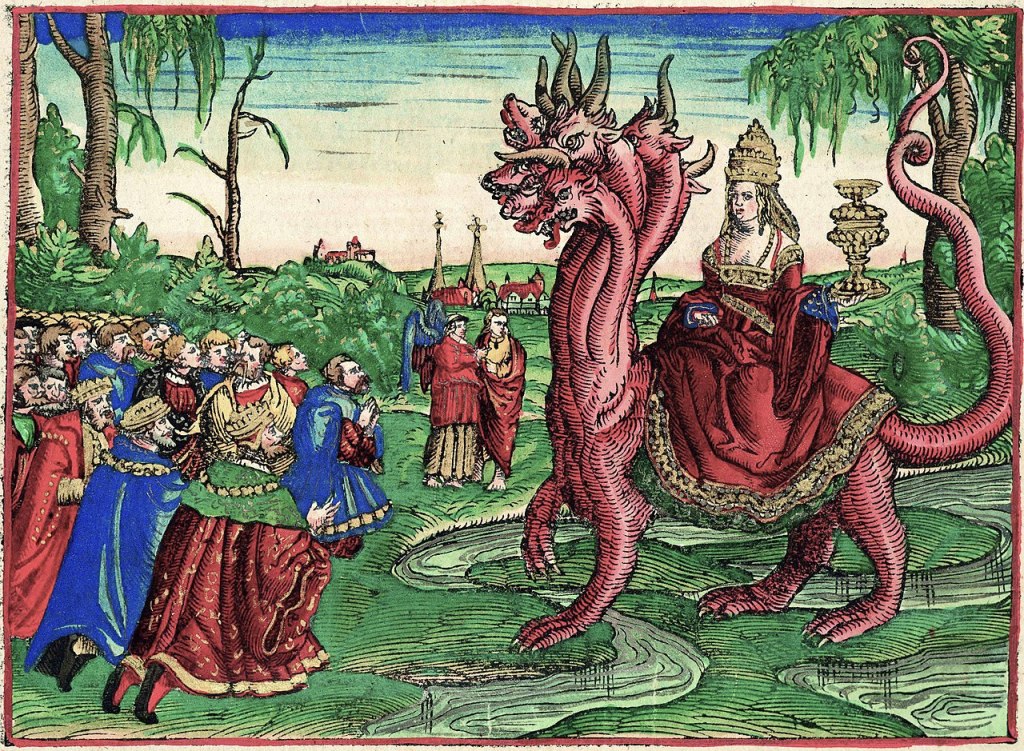
The Allure of Empire Then & Now
But what *exactly* was so seductive about Rome to believers in the early Church? Is such a thing happening still today?
How might we know that we’re in bed with Empire nowadays?
The Roman imperial cult had a far-reaching grip on almost all aspects of society in the first century world, even in Asia Minor. [2] Those who would not offer sacrifices to the emperor were looked at with suspicion at best. By not participating, one risked being barred from membership in trade guilds. If you were not a part of a trade guild, you could not buy or sell anything in the marketplace. On the other hand, if you did make regular sacrifices to the emperor, you could elevate your honor within Roman society and open up more avenues for financial prosperity.[3] That is to say, if a Christian worshipped the Roman emperor as a god alongside the LORD, they had the opportunity to gain more social power and comfort.
It isn’t clear how much the early Christians were persecuted by Rome in a violent matter within the first century. There are conflicting historical reports.[4] Yet even if John was writing polemically, or apocalyptically, it is surely the case that Christians in later centuries faced serious persecution at the hands of Rome. Many believers who refused to bow down to Caesar, or renounce Jesus, died by gladiatorial battle or to the teeth of lions.
Interestingly enough, though, after Christianity became Rome’s state religion in the fourth century, the Church faced a persecution of a different sort.
Hilary of Poiters, in a letter against Emperor Constantinus, wrote: “But today we fight an insidious persecutor, an enemy who flatters, the Antichrist Constantius. He does not stab us in the back but fills our stomachs, does not seize our property to lead us to life but stuffs our pockets to lead us to death, does not free us by putting us in prison but enslaves us by attendance at court, does not lash our bodies but steals our hearts, does not behead us with swords but kills the spirit with gold…He confesses Christ to deny him, seeks uniformity to banish peace…He honors you, O God, in words on his lips, yet does all he can to weaken belief in you as Father of all.”[5]
In other words, the Roman emperors in that time were attempting to co-op Christianity in order to serve their own imperial purposes. They were showering believers with wealth and power so that Christians, in turn, might give a stamp of approval on the political dealings of the Roman state. It was a persecution of flattery. It was an invitation to water down Jesus by mixing Him with Empire.
This form of persecution is very prevalent today.
Many politicians promise power to religious leaders in exchange for support. Many believers imagine that the only way that security, morality, or the survival of Christianity can be achieved is to throw weight behind a political party (in order to secure Supreme Court justices, or other such things). Yet, Jesus needs no help bringing about His kingdom nor can anything on earth threaten His coming reign.
When we begin to think about political wins as wins for Jesus, we may very well be in bed with Babylon.[6]
We would do well to take the advice Augustine offers us within his commentary on Revelation 18:4: “We must renounce our rights as citizens of this world and flee unto God on the wings of faith.”[7] We would do even better to take to heart John’s warning in Revelation 18:4 lest we be counted amongst the ones who face God’s judgement:
“Pull out of her, my people, so that you will not share in her sins, so that you will not receive any of her plagues.”
[1] See: Revelation 17:5
[2] G.K. Beale, Revelation: A Shorter Commentary, (Eerdmans, Grand Rapids, MI; 2015), 61.
[3] G.K. Beale, Revelation: A Shorter Commentary, (Eerdmans, Grand Rapids, MI; 2015), 61.
[4] See: Brent D. Shaw, “The Myth of Neronian Persecution,” The Journal of Roman Studies 105 (2015): 73–100. http://www.jstor.org/stable/26346894.
[5] Constantinus’ aim was to force the fourth century church to accept the heresy of Arianism (that Jesus was not fully God like God the Father is). He used a lot of flattery in attempts to bring Arians and orthodox Christians into some sort of agreement as peace amongst warring religious factions would benefit him politically. Yet he also wasn’t above sending dissenters into exile when they were outspoken against his rule – as Hilary was sent into exile for standing up against the emperor. See: Imperial invectives against Constantius II: Athanasius of Alexandria, History of the Arians, Hilary of Poitiers, Against Constantius and Lucifer of Cagliari, The necessity of dying for the Son of God / translated with introduction and commentary by Richard Flower.
[6] For more about this point, see my other blog here: https://scripture-simplified.com/2024/11/08/post-election-thoughts/
[7] St. Augustine, De Civ. Dei 18.18
 Scripture Simplified
Pingback: Persecution of Flattery: an example | Scripture Simplified