“These are the names of the warriors whom David had: Josheb-basshebeth a Tahchemonite; he was chief of the Three; he wielded his spear against eight hundred whom he killed at one time…” – 2 Samuel 23:8
If you’ve ever attended a men’s ministry retreat, I’m sure you’ve heard about David’s Mighty Men.
They appear in 2 Samuel 23:8-39.[1] There are 37 men in total. And some of their listed feats are rather impressive. Eleazar, one of “the three” continued to fight a group of Philistines even after the rest of Israel retreated. He fought until his hand stuck to his sword and the Philistines were driven off. There’s also Josheb-basshebeth who slew 800 men in one battle with only his spear. Benaiah killed a lion in a snowy pit. 2 Samuel 23:21 also states that Benaiah valiantly slew a “handsome Egyptian,” the significance of which is lost on me.
Yet, what is the purpose of this list? Is it just for fun? It is trying to show us the bravery of David’s military elite? Is it trying to challenge us to be courageous like these men once were? Is it warning us about the dangers of handsome Egyptians?
What’s really going on here?
2 Samuel’s Priestly Appendix
Lots of Old Testament scholars[2] have pointed out that the main story of 2 Samuel seems to officially end in chapter 20. The remaining four chapters, then, have been surmised to be a sort of priestly appendix to the entire narrative of 1-2 Samuel. They are a step outside of chronological time. They are an editorialized comment on the person of David, the kingship, and the state of Israel under his rule.
2 Samuel 21-24 also contains a chiastic structure, a stylized way of highlighting the connectedness of these last chapters:
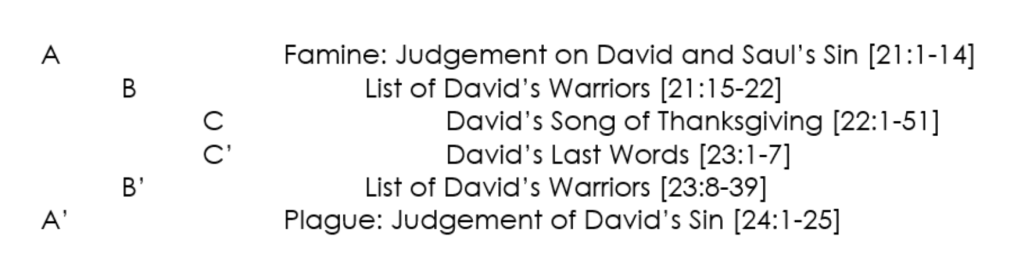
The list that’s often been called “David’s Mighty Men” is the one that appears in B’. It’s the second to last movement within the priestly appendix, and its position as such isn’t accidental.
David’s Mighty Men – What’s Going on Here?
In order to understand this list, we first need to know a bit about ancient Near Eastern kings and kingdoms of which David was one.
It was common in the ancient world for kings to be regarded as deities, or at least pseudo-deities. Egyptian Pharoah’s were venerated as the earthly embodiments of Horus or Ra. In Babylonian and Assyrian cultures, kingship was understood as a divine gift from the gods. Because of this, ancient Near Eastern kings could act in divinely authoritative ways. They held absolute power. Their words were taken as the words of Marduk or Asher. Citizens of their kingdoms would pay homage to them like they might to a god. And more, the mistakes or moral failings of these kings were often swept under the rug or ignored. Who would dare to go up against the human embodiment of Ba’al? Who would speak out against an individual that controlled an entire nation’s army?
The epilogue of the Samuel corpus is playing on this a bit.
We’ve already seen that David isn’t above utilizing the tactics of ancient Near Eastern kings to secure power for himself in 21:1-14. I’ve written about that episode here. But as this appendix continues, David is further humanized and democratized.
That is, within this Mighty Men list, David is both depicted as weary and thirsty (23:15). Other Israelite warriors are the ones who are credited with major victories and triumphs, not just David alone. And there’s even an odd mention about Goliath too. [3] Did David kill Goliath? Or did Elhanan kill the giant Goliath? While we might never know the true answer, many Old Testament scholars think that 21:19 was included in this priestly appendix in order to combat a bit of national propaganda surrounding David’s fight with the giant in 1 Samuel 17. Was David later given credit for something that he never actually did in order to boost his popularity in the kingdom?
Lastly, it is very important to note the final name in the Mighty Men list: Uriah.
Listing Uriah the Hittite, the soldier that David murdered (to trick others into thinking Uriah got his wife Bathsheba pregnant when she was really impregnated when David raped her), is very intentional. It’s there to remind the reader that David, while king, wasn’t without sin. And he, even as king, should still be held accountable for his actions.
What Lessons *Are* We to Take From the “Mighty Men?”
Ancient Near Eastern kings were thought of as pseudo deities. They had absolute power within the land that they ruled. Any victories that their armies had were credited to the king. They were also not publicly accountable for their moral failings. However, in the Mighty Men list, we see David depicted as merely human. He gets tired and thirsty. His troops get the credit for military exploits and are appropriately honored. David is also held accountable for his sin against Uriah and Bathsheba.
The Mighty Men list is there to rightly put David in his place. He isn’t superhuman. Sometimes he does the right thing. Sometimes he does terrible things. He’s a sinner just like the rest of us.
It is also there as a comment on leadership as a whole:
Beware of kings, presidents, or pastors who insist on taking all of the credit for that which was a group effort.
Beware of any leader who plays into propaganda to make themselves look better or to amass more power.
Beware of anyone who refused to be held accountable for their mistakes for we all will be judged in the end (Ecclesiastes 12:14).
[1] A version of this list also appears in 1 Chronicles 11:10-47.
[2] Karl Budde, Robert D. Bergen, Walter Brueggemann, Rolf A. Carlson, among others.
[3] See: 2 Sam 21:19, 23:24. Elhanan’s giant slaying story doesn’t actually appear in the mighty men list, but in a different list in 2 Samuel 21. However, his name is still included in the mighty men without the details of this story.
 Scripture Simplified